From Paper to Steel: Creating and Verifying Your Bitcoin Backup Safely
Schützen Sie Ihre Bitcoin Seed Phrase vor Feuer und Wasser. Praktische Anleitung für ein fehlerfreies und dauerhaftes Backup auf Stahl.
Contents
Fundamentals of Secure Bitcoin Self-Custody
Holding your own Bitcoin is a conscious decision for financial independence. This self-custody relies on one central element: the seed phrase (usually 12 or 24 words). It serves as the physical master key to your wealth and acts as a universal recovery key.
In practice, almost all beginners start with a handwritten paper backup. But paper is transient. It burns, molds, tears, or fades over the years. To secure your financial sovereignty for the long term, moving from paper to a resilient steel backup is the logical next step when securing your seed phrase.
Risks of Conventional Paper Backups in Everyday Life
A paper backup is inexpensive and quick to set up. However, as a permanent storage method, it carries significant risks that are often underestimated in daily life when storing valuable Bitcoin:
House fires easily reach temperatures exceeding 600 °C. Paper burns instantly under these conditions; even standard household document safes often fail to provide sufficient protection against the extreme heat conduction inside, which chars the paper.
Furthermore, burst pipes, floods, or simply fire extinguishing water can destroy ink and paper within minutes. Gradual processes such as humidity, paper acidity, and mold also render handwritten notes illegible over decades. A fireproof metal backup is the only safe alternative here.
Comparing Different Metal Backup Systems
There are several methods for creating a robust steel Bitcoin backup. Each approach has specific advantages and disadvantages regarding handling, cost, and error tolerance.
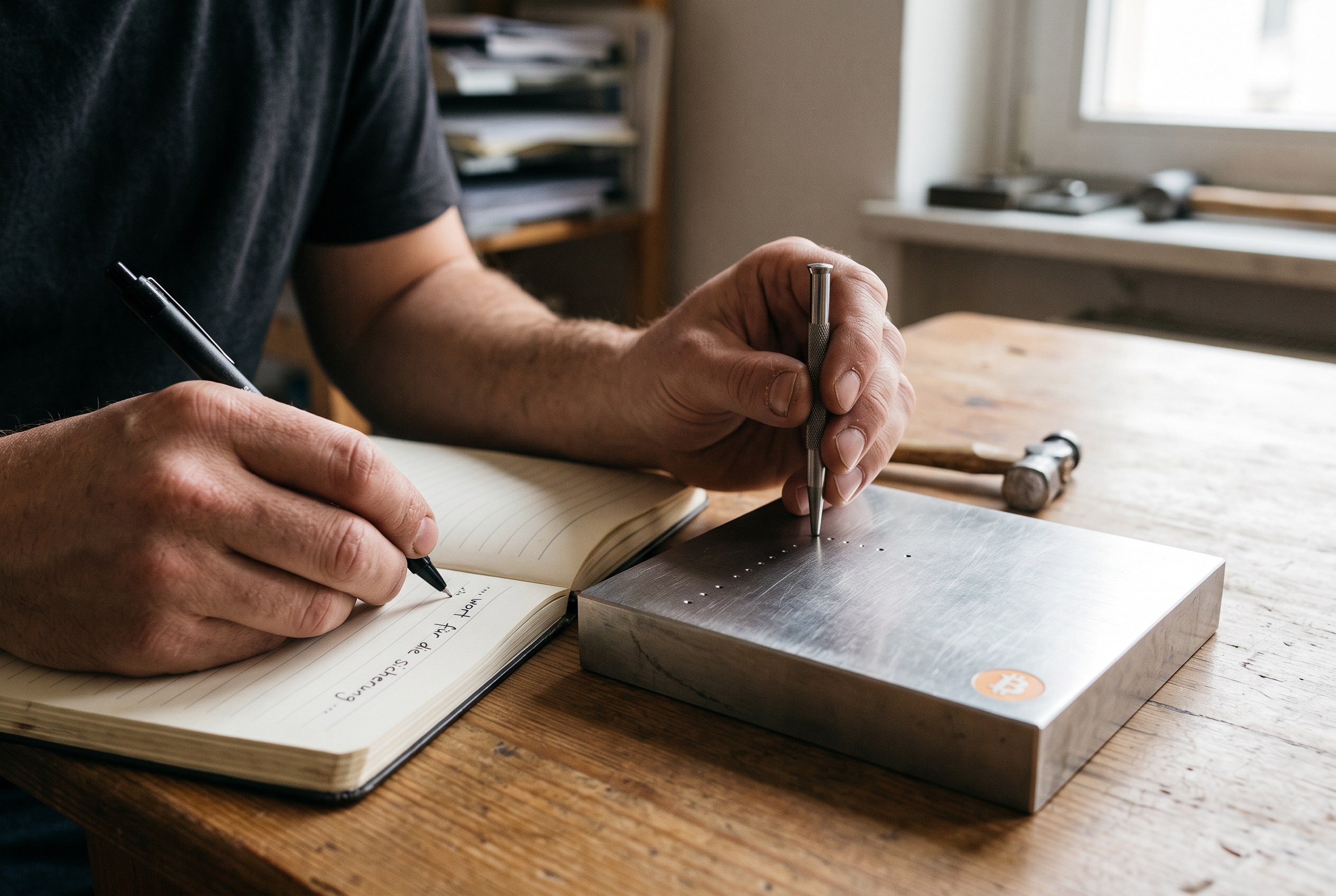
The metal stamp method is the most robust DIY option, but requires manual dexterity. Cassette systems with pre-made letter tiles, often sold commercially as Crypto Steel, are highly legible but carry the risk of the rails opening under severe mechanical deformation. Grid-based punch card systems offer highly discreet encoding using center punches, but leave virtually no room for error when punching.
flowchart LR
%% Comparison of Metal Backup Systems
    node_0_0["Steel Backup Selection"] --> node_0_1["Stamps & Plates"]
    node_0_1["Stamps & Plates"] --> node_0_2["Maximum physical durability, no moving parts, requires manual preparation"]
    node_0_0["Steel Backup Selection"] --> node_1_1["Cassettes with Tiles (Crypto Steel)"]
    node_1_1["Cassettes with Tiles (Crypto Steel)"] --> node_1_2["Very clean and readable, easy handling, theoretical risk of losing tiles in case of extreme deformation"]
    node_0_0["Steel Backup Selection"] --> node_2_1["Grid / Punch Cards"]
    node_2_1["Grid / Punch Cards"] --> node_2_2["Fast and silent with an automatic center punch, no hammering needed, requires flawless concentration"]
Step-by-Step Guide to Flawless Transfer
The greatest source of error when creating a backup is the human factor. Therefore, proceed methodically and use the standardized BIP39 word list. Since this list contains exactly 2048 words, the first four letters of each word are completely unique. It is entirely sufficient to transfer only the first four letters to your steel backup. For example, the word 'TRAIN' starts with 'TRAI'—no other word on the list shares this sequence. For three-letter words, three letters are sufficient.
Step 1: Create a secure environment. Work completely unobserved. Close windows and curtains. Ensure there are no smartphones, smart home devices, or cameras in the room that could capture the backup visually.
Step 2: Prepare the text. Write down the words to be stamped (or their first 4 letters) on a separate piece of paper. Use this as your direct working template to avoid reading errors from the original document.
Step 3: Stamping or assembling. Secure the steel plate on a solid, vibration-free surface (e.g., a heavy workbench or a paving slab). Apply a piece of masking tape as a guide line. Place the stamp straight and strike firmly once with the hammer to prevent double impressions.
Secure Verification Without Digital Traces
A backup is only as good as its recoverability. Before archiving or destroying your old paper backup, you must verify the new metal backup.
Never perform a 'test recovery' on an internet-connected computer or smartphone! Typing your private words into a digital keyboard immediately destroys the security advantage of a hardware wallet. Instead, use the built-in 'Recovery Check' feature of your hardware wallet. Many common devices offer this option, where the words are entered directly on the isolated device and verified against the internal private key without any sensitive data leaving the device.
Physical Storage and Effective Theft Protection
Steel protects against physical elements like fire and water, but not against theft. Anyone who gains physical access to your seed phrase controls your entire cryptocurrency wealth.
Avoid obvious hiding spots like the classic bedroom safe, which is the first target during burglaries. Unconventional locations, such as behind wall panels, inside cavities, or integrated into inconspicuous household items, often provide better protection.
In addition, you should use opaque, numbered tamper-evident bags to immediately detect any access attempts. For an extra layer of security, we recommend using an optional passphrase (also known as the 25th word), which is stored separately or memorized, denying unauthorized finders of the steel backup access.
Long-Term Protection for Your Digital Assets
Transitioning from paper-based storage to an engraved or stamped steel plate requires a high level of concentration and a small one-time investment in robust materials. However, once this step is completed precisely and error-free, the risk of total loss from physical disasters drops to near zero. In doing so, you establish an indestructible, offline-secured foundation for the independent custody of your digital assets over decades.